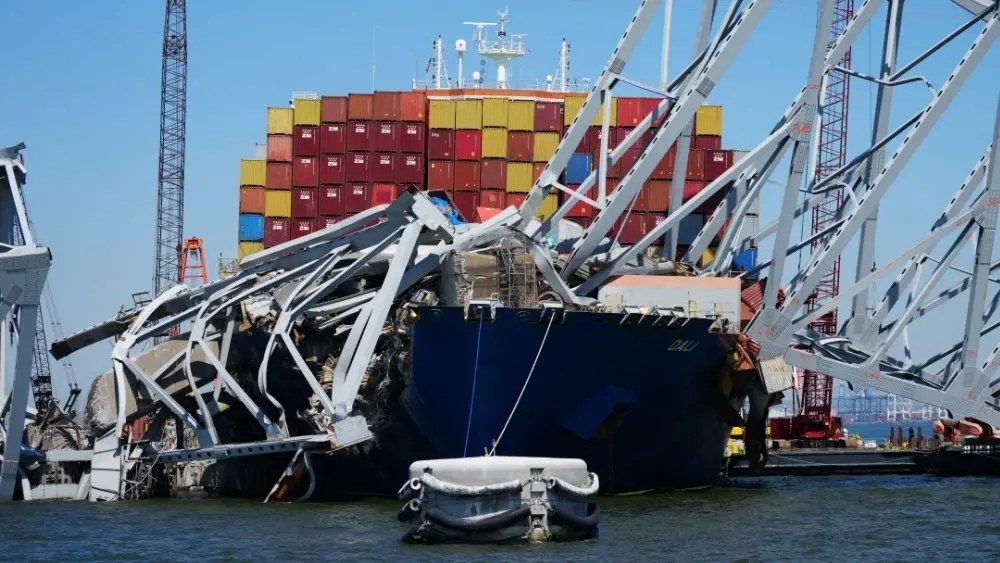
Federal prosecutors have brought criminal charges against the companies responsible for operating the cargo ship that struck Baltimore’s Francis Scott Key Bridge in March 2024, triggering a catastrophic collapse that killed six construction workers and caused billions of dollars in damage.
The Justice Department announced Tuesday that Singapore-based Synergy Marine and its India-based affiliate, along with technical superintendent Radhakrishnan Karthik Nair, were indicted on multiple counts tied to the crash involving the container ship Dali. Authorities say the tragedy stemmed from preventable mechanical and operational failures aboard the nearly 900-foot vessel, which lost power twice while departing the Port of Baltimore before crashing into the bridge during the early hours of March 26, 2024.
The 18 charges listed in the unsealed indictment include conspiracy to defraud the United States, failing to report a known safety hazard to the U.S. Coast Guard, obstruction of an agency investigation, false statements, and misconduct by ship officers resulting in death.
Six road workers repairing potholes on the bridge were killed when the structure collapsed into the Patapsco River. Another worker survived with serious injuries. The disaster also shut down Baltimore’s busy shipping channel for weeks and launched a costly rebuilding effort expected to continue for years. “The collapse should never have happened,” said FBI Baltimore Special Agent Jimmy Paul, who accused those responsible of prioritizing convenience over safety.
According to prosecutors, operators knowingly relied on an improper fuel system setup for years. Instead of using standard diesel supply pumps equipped with backup systems and automatic restart capabilities, the ship allegedly depended on a “flushing pump” — equipment intended only for maintenance purposes. Investigators believe the pump failed during the vessel’s second blackout, preventing the ship from restoring power quickly enough to avoid the bridge. Maryland U.S. Attorney Kelly Hayes said the indictment argues the Dali could have safely passed beneath the bridge had proper fuel pumps been in use.
Officials also allege company personnel attempted to conceal the risky setup after the crash by removing references to the flushing pump from ship logs, engineering records, audits, and crew documentation. Prosecutors say Nair later falsely claimed to National Transportation Safety Board investigators that he had no knowledge of the system being used in that way. A National Transportation Safety Board report released last year found the Dali’s initial power failure was triggered by a loose wire inside the ship’s switchboard, which shut down critical cooling systems and temporarily disabled steering. Although power briefly returned, the second outage proved fatal.
Beyond the criminal case, the ship’s operator and owner have already faced a wave of civil lawsuits from victims’ families, government agencies, businesses, and other affected parties. Previous settlements with the Justice Department and Maryland authorities exceeded $100 million, though additional legal battles remain pending.
Attorneys representing several victims’ families described Tuesday’s indictment as a major moment for accountability within the shipping industry, arguing the allegations reveal deliberate efforts to mislead investigators after the crash.
Editorial credit: Andrew Leyden / Shutterstock.com